/Operator
AI Launch Readiness Checklist For Marketing
A practical AI launch readiness checklist for marketing teams that need to test ownership, data, review, risk, and rollout before go-live.
Short answer
An AI launch readiness checklist helps marketing teams decide whether a workflow is ready to go live by checking ownership, inputs, review, measurement, risk, and rollback before launch.
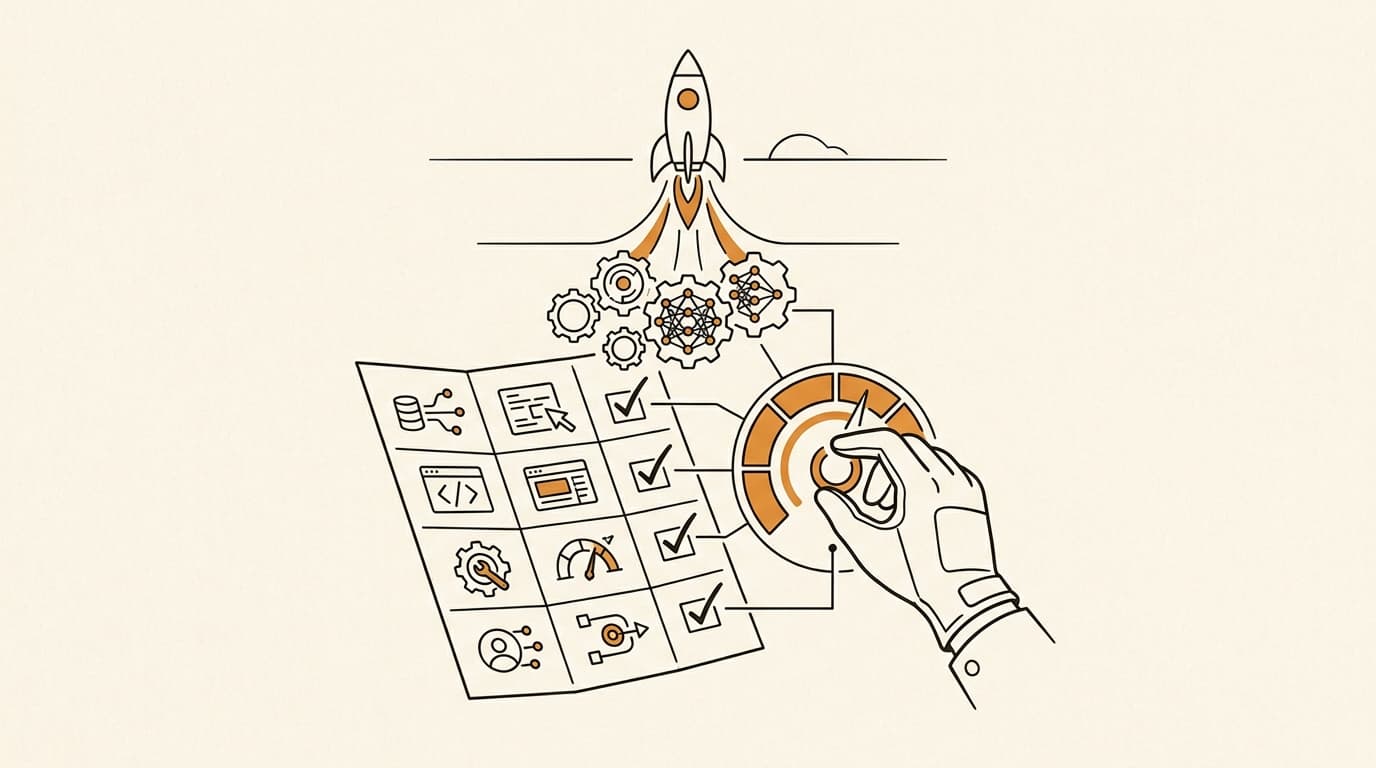
AI launch readiness is not the same as demo readiness.
A demo asks, "Can this work once?"
A launch checklist asks, "Can this run when real people, real deadlines, and real mistakes show up?"
That second question is less exciting. It is also the one that protects the team.
The checklist
Before launching an AI-assisted marketing workflow, check seven areas.
1. Workflow scope
Can you describe the workflow in one sentence?
Weak:
We are launching AI for reporting.
Better:
Every Monday, the analytics lead uses AI to draft the first performance narrative for the weekly pacing meeting.
If the scope is vague, the launch will be vague too.
2. Owner
Who owns the workflow after launch?
This is not always the person who built the prompt or the prototype. The owner is the person responsible for deciding whether the workflow continues, changes, or stops.
Write the name or role down.
3. Inputs
What inputs are allowed?
What inputs are not allowed?
Marketing teams often skip this because the demo uses clean examples. Real launch does not. It uses messy briefs, partial data, old naming conventions, missing context, and stakeholder comments copied from five different places.
The checklist should name the minimum acceptable input.
4. Human review
What cannot be automated?
This is the most important part of the checklist.
Write the rule in operational language:
AI may draft the summary. The account lead approves any client-facing recommendation, budget implication, or claim about performance causality.
That is stronger than saying, "human in the loop."
5. Measurement
What will you compare against?
Use a small measurement set:
- cycle time
- correction count
- user adoption
- quality rating
- risk or rework events
Do not launch with only a productivity claim. Productivity without quality can be a trap.
6. Rollback
What happens if the workflow causes problems?
Every launch needs a stop condition. For example:
- two factual errors in client-facing output
- reviewer cannot explain the recommendation
- cycle time gets faster but rework doubles
- the intended user stops using the output
Rollback is not failure. It is responsible launch design.
7. Communication
Who needs to know what changed?
A small internal workflow may only need one message. A client-facing workflow may need a clearer explanation of what AI does and what humans still approve.
Do not over-announce. Do not hide it either.
What Prova reviews that generic AI often misses
Generic AI can turn this checklist into a polished launch plan.
What it may miss is whether the plan can actually run.
Prova should push on:
- whether the workflow scope is specific enough
- whether the human review rule has teeth
- whether the measurement compares against a real baseline
- whether the rollback condition is explicit
- whether the owner can make a decision after two weeks
Those are not writing issues. They are operating issues.
A simple readiness score
For each area, use this scoring:
- Not ready: vague, missing, or dependent on hope.
- Needs revision: partly defined, but not enough to run.
- Ready to test: specific enough for a two-week pilot.
If any of owner, review, inputs, or rollback scores a 1, do not launch yet.
That may feel conservative. It is usually cheaper than cleaning up a bad launch.
That is it from me for now. If you are preparing an AI workflow for launch, which part of this checklist feels weakest?