/Leader
AI Operating System For Marketing Teams
A practical way to turn AI experiments into a marketing operating system with owners, rhythms, review points, and evidence.
Short answer
An AI operating system for marketing teams defines the repeated workflows, ownership, review rhythm, measurement, and decision rules that let AI support real work without becoming scattered tool use.
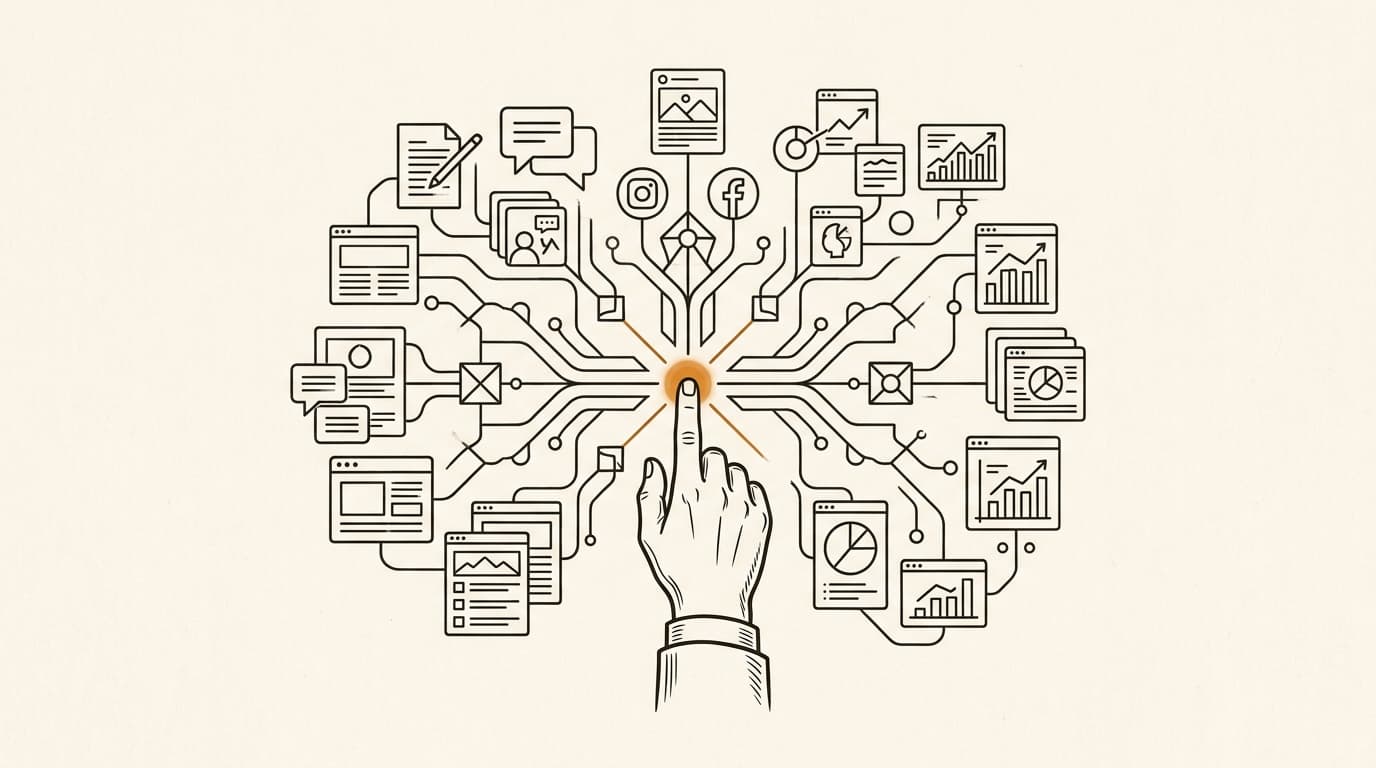
Most teams do not need another AI idea.
They need a way to make the ideas survive the week.
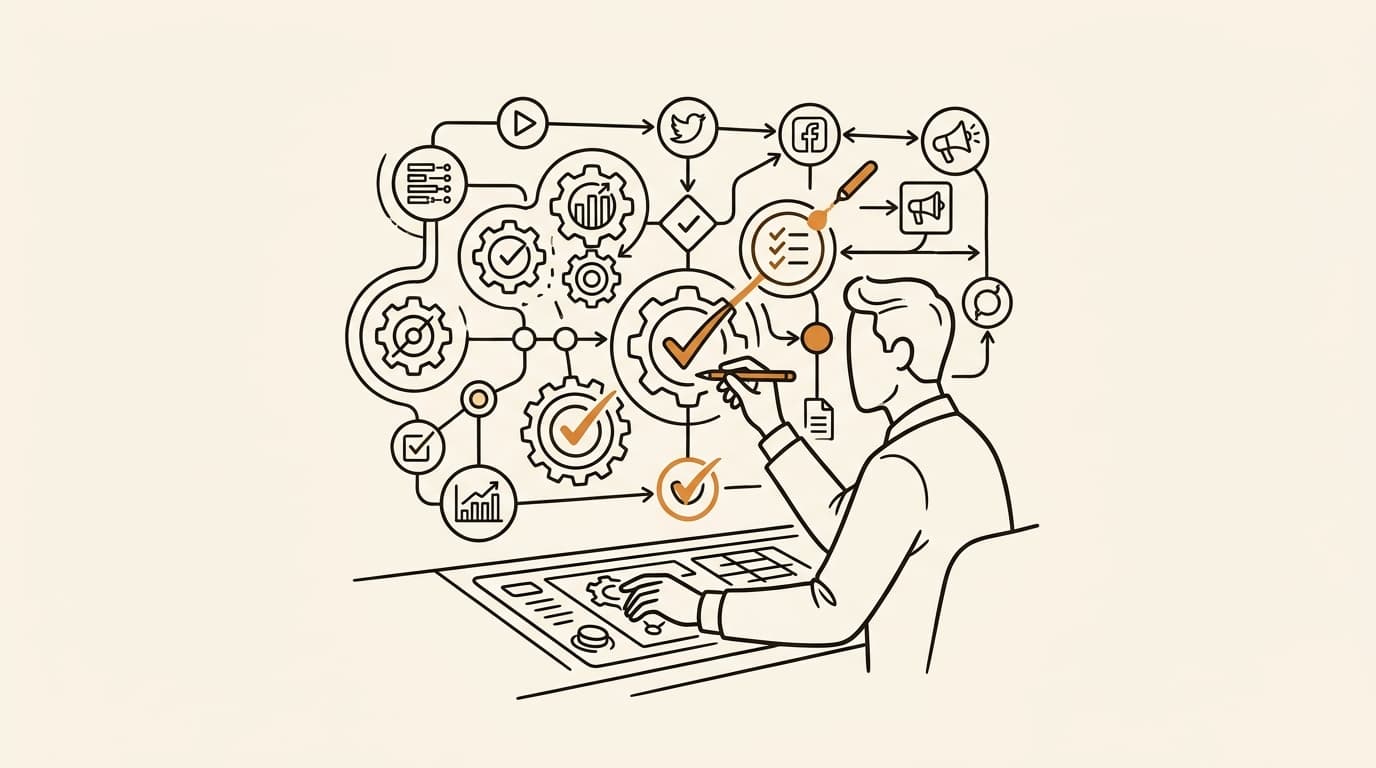
That is what I mean by an AI operating system for marketing teams. It is not a new department, a big deck, or a list of approved tools. It is the small set of workflows, owners, review points, measures, and meeting rhythms that make AI usable in real marketing work.
I have to admit, I used to underestimate this part. The exciting part was always the demo. The harder part was making the demo fit the handoffs, approvals, reporting expectations, and client or leadership conversations that already existed.
What is an AI operating system?
An AI operating system is the way a team decides where AI enters the work, who owns the output, how quality is reviewed, and what evidence decides whether the workflow keeps going.
It should answer five questions:
- Which repeated workflow are we changing?
- Who owns the decision?
- What input is reliable enough to use?
- Where does human review stay non-negotiable?
- What metric tells us whether the change helped?
If those answers are missing, the team does not have an operating system. It has experiments.
Experiments are fine. The mistake is pretending the experiment is adoption.
Start with the workflow, not the tool
The operating layer starts with one repeated workflow.
For example:
- weekly performance reporting
- creative brief intake
- competitor scan
- campaign launch readiness
- client or executive status update
- media pacing review
Do not start by saying, "We should use Gemini for insights" or "We should use Claude for strategy." Those statements may be true, but they do not name the work.
A better starting point is:
Every Monday, the growth lead needs a first-pass performance narrative that separates what changed, what matters, and what decision is needed before Wednesday's pacing meeting.
That sentence gives the team something to operate. It names the rhythm, user, output, and decision.
Define the human review points
AI creates trouble when teams treat review as politeness instead of control.
For each workflow, write down what AI can draft and what a human must approve.
Weak version:
A strategist reviews the output.
Better version:
The strategist approves any recommendation that changes budget, channel mix, audience targeting, or client-facing explanation. AI may draft the narrative, but it cannot make the final judgment.
That difference matters. The first version sounds responsible. The second version can be run.
Build the measurement rhythm
The operating system also needs measurement, but not too much.
For a first workflow, I would track four things:
- Speed: did cycle time improve?
- Quality: did the output require fewer corrections?
- Adoption: did the intended user actually use it?
- Risk: did mistakes, rework, or trust issues increase?
The point is not to prove AI is amazing. The point is to know whether the workflow is safer, faster, or clearer than before.
From my experience, the risk metric is often the missing one. A team celebrates that a report was produced faster, but nobody counts the extra review time needed to make it safe.
Create one weekly operating review
If nobody reviews the system, it decays.
A lightweight weekly review is enough:
- What workflow ran this week?
- What changed versus the old way?
- What did the reviewer catch?
- What should be changed before the next run?
- Should we continue, pause, or scale?
This is boring work. It is also how trust forms.
The operating review prevents AI adoption from becoming a collection of screenshots and stories. It turns the work into a sequence of decisions.
Where Prova fits
Prova is built around this operating idea. You do one sprint, submit one artifact, get review, and then move to the next step.
That is different from asking ChatGPT, Claude, or Gemini to make a plan. Those tools can help you draft. They do not naturally hold the workflow audit, measurement architecture, reporting rhythm, rollout plan, and review history together as one progression.
The operating system is not the software. It is the discipline around the work.
Prova is meant to make that discipline easier to keep.
The first version
If I were helping a marketing team start this next week, I would keep it small:
- Pick one repeated workflow.
- Write the current trigger, owner, input, output, and decision.
- Decide what AI can draft.
- Decide what must stay human.
- Choose one speed metric, one quality metric, and one risk signal.
- Run it for two weeks before expanding.
That is enough to learn something real.
It is not enough to transform the department, and that is fine. The first job is to make one workflow more honest.
That is it from me for now. If your team had to choose one workflow to put into an AI operating system, which one would survive review first?
Cheers, Chandler