/Leader
AI Vendor Evaluation Scorecard For Marketing
A practical AI vendor evaluation scorecard for marketing teams comparing tools, pilots, risk, workflow fit, and support burden.
Short answer
An AI vendor evaluation scorecard helps marketing teams compare tools by workflow fit, data boundaries, review controls, integration cost, measurement, and support burden instead of demo appeal.
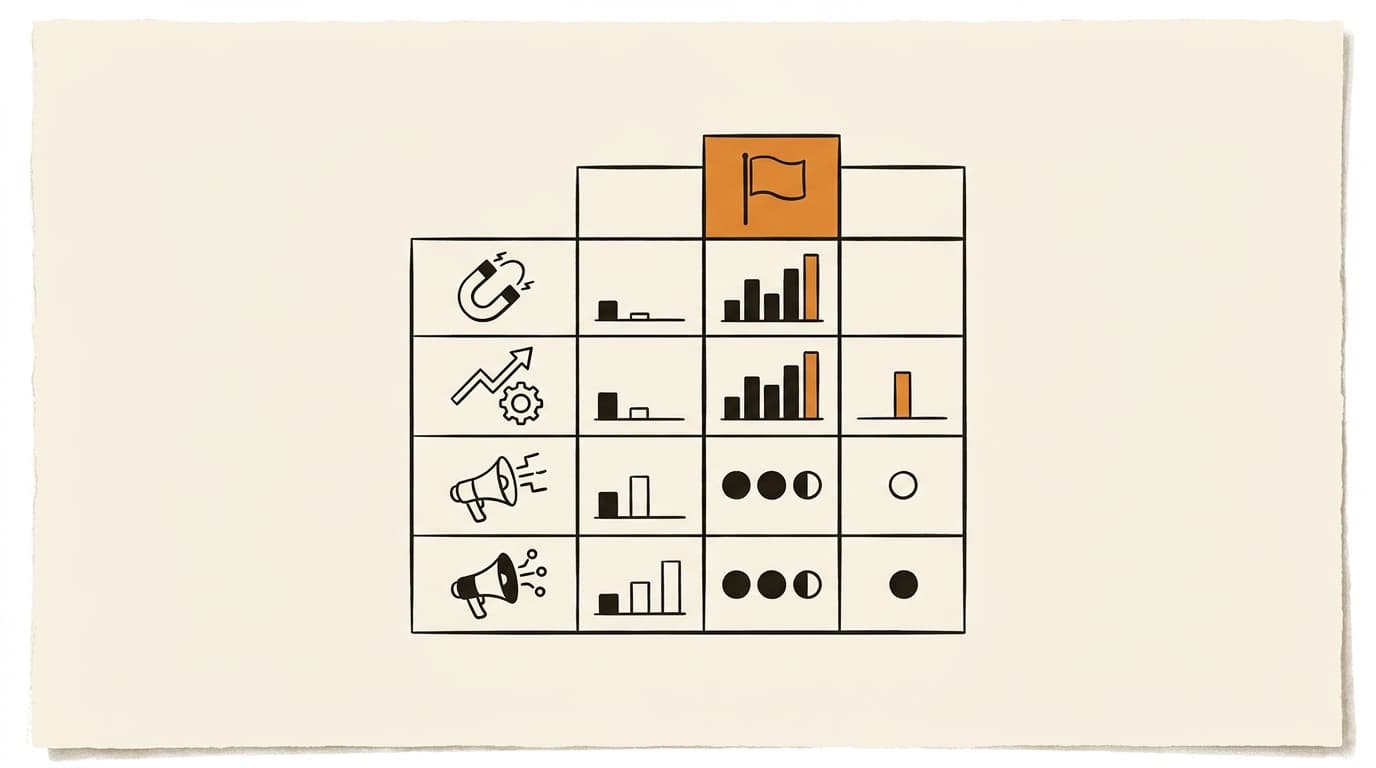
AI vendor evaluation gets messy when the demo is the main evidence.
A demo shows what the tool wants you to see. A scorecard should show whether the tool fits your work.
I do not mean that vendors are trying to mislead you. Many demos are genuinely useful. The problem is that marketing teams often evaluate the tool before they define the workflow.
That order creates bad buying decisions.
The scorecard
Use a 1 to 3 score for each area.
1 means weak or unclear. 2 means workable but risky. 3 means strong enough to pilot.
1. Workflow fit
Does the vendor solve a specific repeated workflow?
Weak:
This tool can help our team use AI.
Better:
This tool can reduce first-draft reporting time for weekly campaign reviews without changing the approval owner.
If the workflow is not named, the score should be low.
2. Data boundary
What information enters the tool?
What should never enter it?
Marketing teams need this before procurement, legal, or client stakeholders ask. A vendor that cannot explain data boundaries clearly is not ready for sensitive workflows.
3. Review control
Where can a human approve, edit, reject, or audit the output?
For many marketing workflows, review control is not optional. It is the difference between a draft assistant and an operational risk.
4. Integration burden
How much work is required before the tool fits the current system?
Include:
- data setup
- permissions
- workflow changes
- training
- support
- reporting changes
The tool may be good and still be too heavy for the first pilot.
5. Measurement
Can the team measure whether the tool helped?
Do not accept "time saved" as the only metric unless the workflow has no meaningful quality or risk dimension.
For marketing work, measure speed, quality, adoption, and rework.
6. Support burden
Who handles errors, confused users, prompt changes, and stakeholder questions?
This is easy to ignore because it appears after purchase. It should be part of the evaluation.
What Prova reviews that generic AI often misses
Generic AI can help create a vendor comparison table.
What it may not challenge is whether the comparison is grounded in the team’s actual operating reality.
Prova should review whether:
- the workflow is specific enough
- the scoring criteria match the use case
- the data boundary is explicit
- the review control is real
- the team has named the support owner
- the scorecard separates demo appeal from operational fit
That last separation is important. A tool can be impressive and still be wrong for the first pilot.
A simple decision rule
Use this rule after scoring:
- If workflow fit is below 3, do not buy yet.
- If data boundary or review control is 1, do not launch with real data.
- If integration burden is 1 but the pilot is urgent, reduce the workflow scope.
- If support burden has no owner, pause.
This rule is intentionally strict. The scorecard is not there to make a purchase feel scientific. It is there to protect the team from a tool decision that creates more work than value.
The best vendor question
Ask the vendor:
Show us how this works inside one workflow we already run every week, including the review step and the failure path.
If the answer stays at the feature level, you learned something useful.
That is it from me for now. If you are evaluating AI vendors, which one looks best in the demo but weakest inside the real workflow?