/Builder
From Prompting To Building A First Useful Slice
A practical way for marketers to move beyond prompts and define one visible AI-assisted slice a real user can test.
Short answer
Moving from prompting to building means choosing one visible slice for one real user, then defining what the user can test and what must stay out of scope.
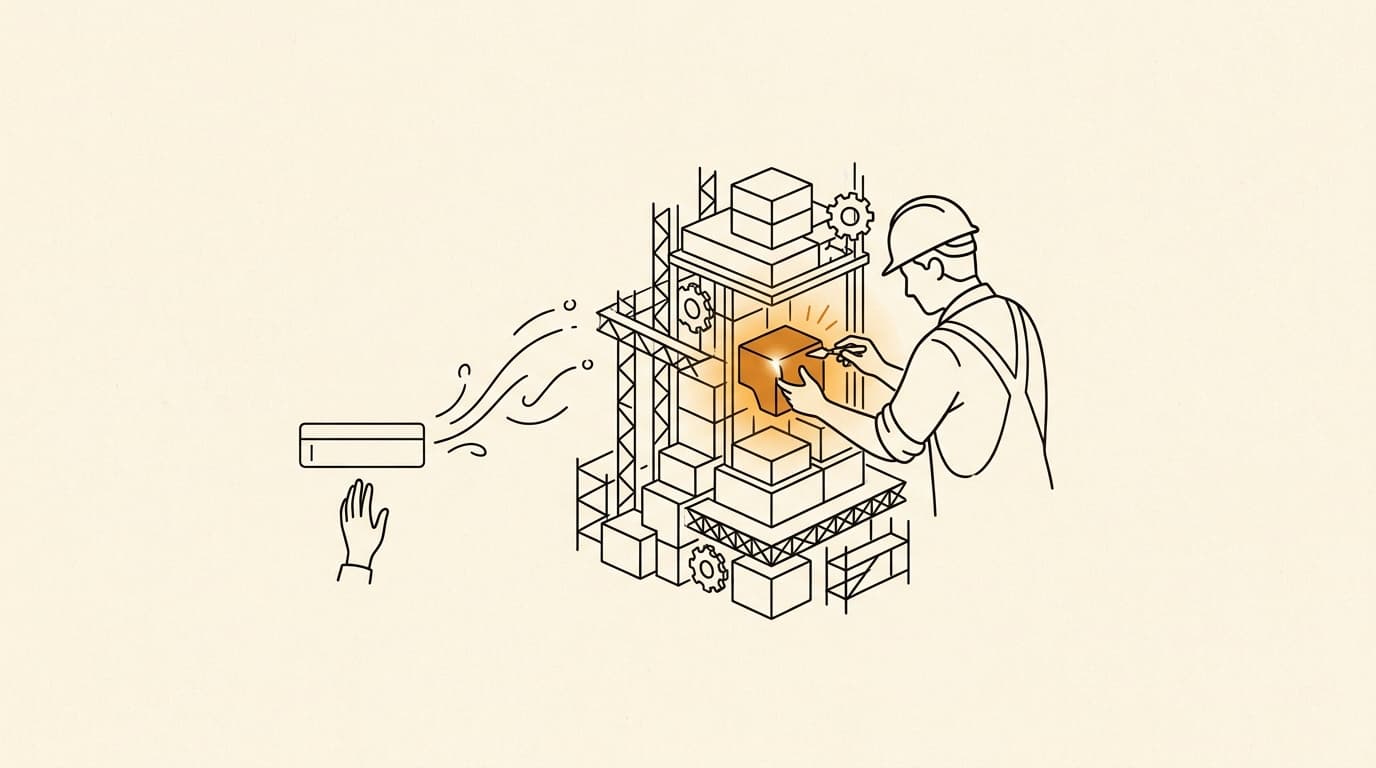
Prompting is useful. It is also a comfortable place to hide.
You can spend weeks improving prompts, testing tools, saving examples, and still never put anything in front of a real user. I have done versions of this myself. My version usually had a serious-looking folder name and no one outside my laptop who could use it. It feels productive because there is motion. But no one else can use the thing yet.
The builder move is different.
You define one visible slice and make it testable.
What counts as a slice
A slice has four parts:
-
One user
Not a market. A person or role. -
One repeated job
Something that happens often enough to matter. -
One output
A draft, note, score, recommendation, brief, or handoff. -
One review moment
A place where a human can accept, correct, or reject the output.
Bad slice:
Build an AI account management assistant.
Better slice:
Help one account lead turn a messy client question thread into a pre-call decision note, then require a human to approve the recommendation before it is shared.
The second one is smaller, but it can be shown.
Why marketers have an advantage
Marketers know work that engineers may not see.
You know which brief causes three rounds of confusion. You know which report nobody reads. You know which handoff looks fine in the process doc but breaks every Thursday.
That knowledge is valuable. But it has to become a build brief.
A build brief names the user, the problem, the first output, the risk, and the acceptance criteria. Without that, AI can generate a lot of code in the wrong direction.
How Prova handles this
The Builder path in Prova starts with a reality check, then a project brief, then a build plan. That sequence is deliberate.
If the reality check is weak, the brief will be fantasy. If the brief is vague, the build plan will become theater. If the build plan ignores QA, the launch gate will catch it too late.
I might be wrong, but I think this is where many non-technical builders get hurt. They do not fail because they lack ideas. They fail because the first slice is too vague to test.
Start smaller.
Make one thing visible.
Let someone real react to it.
What is the smallest slice you would be slightly embarrassed to show, but could still learn from?
Cheers, Chandler