/Proof
Build vs Buy vs Prompt: How To Choose Your AI Marketing Strategy
Most marketing teams default to buying AI tools or prompting ChatGPT directly.
Short answer
Marketing teams have three options with AI tools: buy software, prompt a general-purpose chatbot, or build something custom.
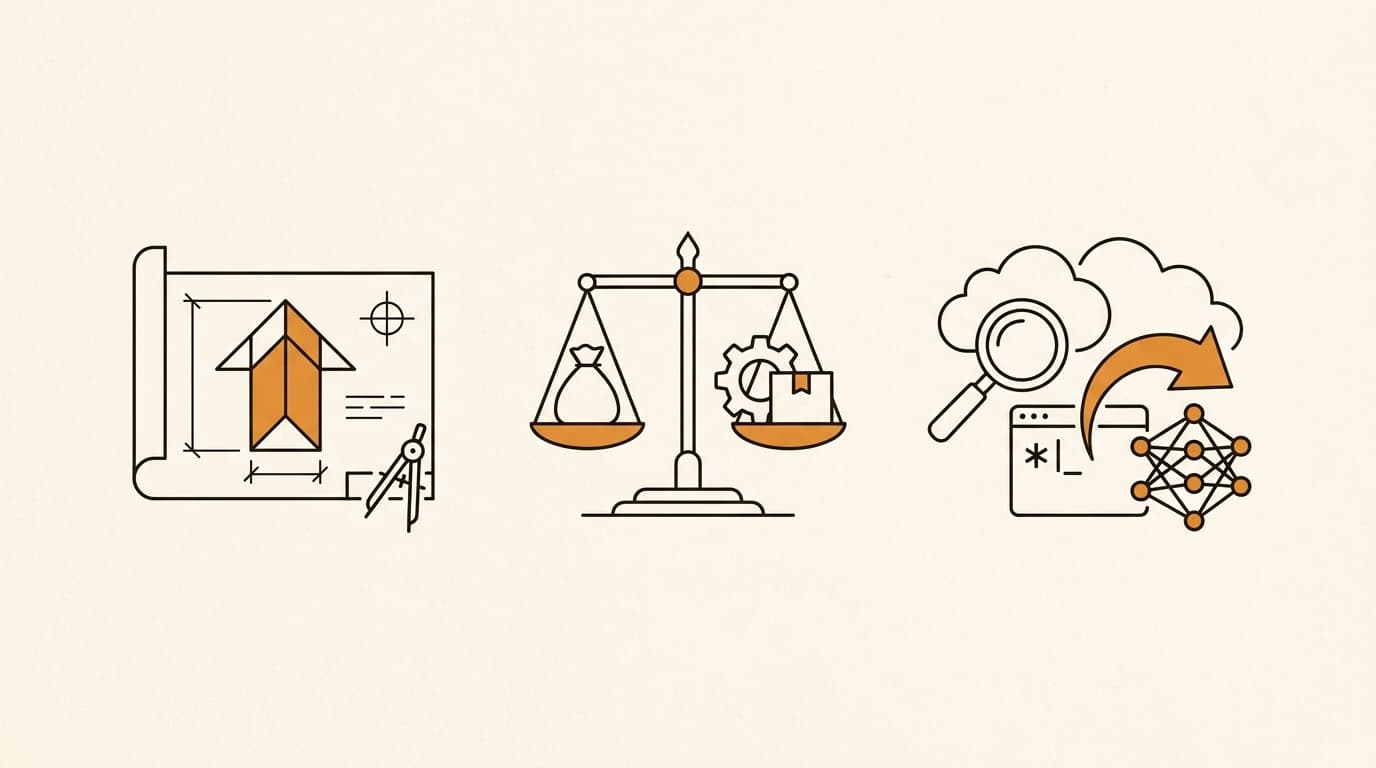
When someone on your team says "we should use AI for this," the default is usually one of two things: buy a tool or open ChatGPT.
There is a third option. You can build something custom. And in more cases than most marketing teams realize, building is the most practical choice.
I faced this decision repeatedly before building Prova. Each time I needed an AI-assisted workflow — competitive intelligence, content review, sprint review logic — I had to decide whether to buy a platform, prompt a general-purpose model, or build something specific. I made each choice at different points. I was wrong about which choice was right more than once.
Here is an honest comparison.
The three paths and what they actually cost
| Build | Buy | Prompt | |
|---|---|---|---|
| Upfront cost | Time to specify, build, and test | Subscription or license fee | Near zero |
| Fit to your workflow | High — you define the behavior | Medium — depends on vendor features | Low — you adapt to the tool's interface |
| Maintainability | You own it; you update it when things break | Vendor updates; you adapt when they change | No maintenance; also no persistence |
| Who does the work | You, with AI assistance | Vendor builds; you configure | You, every time |
None of these are objectively wrong. They are appropriate for different situations.
When prompting is the right call
Prompting a general-purpose model is the correct choice for one-off tasks.
You need to summarize a report you received this morning. You need to draft a quick response to an unusual client question. You need to think through a problem you have not encountered before. Open a chat interface, write a prompt, get an answer, move on.
The limitation shows up when the task is repeated. If you prompt the same kind of task three times a week, every week, you are doing the same specification work repeatedly — writing the same context, the same instructions, the same constraints — and getting inconsistent output because nothing is saved between sessions.
From my experience, the threshold is roughly this: if you do the same type of task more than once a week, prompting starts costing more time than it saves.
When buying makes sense
Buying makes sense when a vendor has already solved the exact problem you have, and when the standard workflow fits your team closely enough.
There are legitimate AI marketing tools that handle things like content generation at scale, SEO audits, paid media optimization, and social listening. These tools have been trained and tuned for those specific use cases. The vendors have invested in interface design, reliability, and edge case handling that you would spend months reproducing from scratch.
Buying is the wrong default when you are paying for features you do not use, when your workflow is non-standard enough that the tool requires workarounds, or when you are buying to say you have an AI strategy rather than because the tool solves a specific problem.
I have bought tools that I used for two weeks before realizing they solved a slightly different problem than mine. That is a real cost. It is also a learning.
When building is the right choice
Building is the right choice when the task is specific to your team's context, repeated frequently enough to justify the setup time, and different enough from what vendors offer that off-the-shelf tools require too many compromises.
Three conditions that favor building:
-
The workflow encodes institutional knowledge. Your specific brief quality criteria, your specific client communication patterns, your specific reporting format. A vendor tool cannot know these. A custom build can encode them precisely.
-
You need the tool to connect to your existing systems. Your client database, your project management tool, your reporting spreadsheets. Building lets you design the integration for your actual setup instead of adapting your setup to a vendor's integration list.
-
The cost of the subscription is disproportionate to the use case. Many enterprise AI platforms charge for breadth that a focused team does not need. A narrow custom tool can handle a specific workflow at a fraction of the cost.
The honest trade-off: building takes real time. A good first version of a narrow custom tool takes two to four weeks of focused work if you have never done it before. You also own the maintenance. When the AI model behavior changes, you update your prompts. When your workflow changes, you update the spec.
What most teams actually do — and why it stalls
Most marketing teams do neither buy nor build deliberately. They start prompting, find it inconsistent, buy a few tools that partially fit, and end up with a fragmented collection of workflows that no one can explain or maintain.
The result is not an AI strategy. It is a pile of AI subscriptions and a team that is spending more time managing tools than doing work.
The teams that get past this have one thing in common: they made an explicit decision about which path to take for each workflow, and then they followed through. The decision does not have to be permanent. Build first, buy later if a vendor solves it better. Buy first, build if the tool does not fit. Prompt for one-off tasks, and stop expecting consistency from an approach that is not designed to be consistent.
The Prova angle
Prova exists, in part, because I built and rebuilt my own AI-assisted workflows before designing a program to teach others to do the same. I made the prompt-to-buy-to-build mistake in that order. I have a folder of vendor tools I trialed and abandoned, a set of prompts that became inconsistent after model updates, and a small number of narrow custom tools that still run for me today.
What Prova teaches is not that building is always right. It teaches the judgment to know when building is worth it and how to do it in a way that produces something a real user will actually use. That judgment is harder to develop than it looks, and it is the thing that separates an AI builder from someone who bought an AI subscription.
Cheers, Chandler