/Builder
AI Prompt Vs AI Workflow: What Every Marketer Needs To Know
A prompt is a single instruction to an AI.
Short answer
A prompt is a single instruction to an AI. A workflow is a repeatable system that chains inputs, instructions, and outputs together.
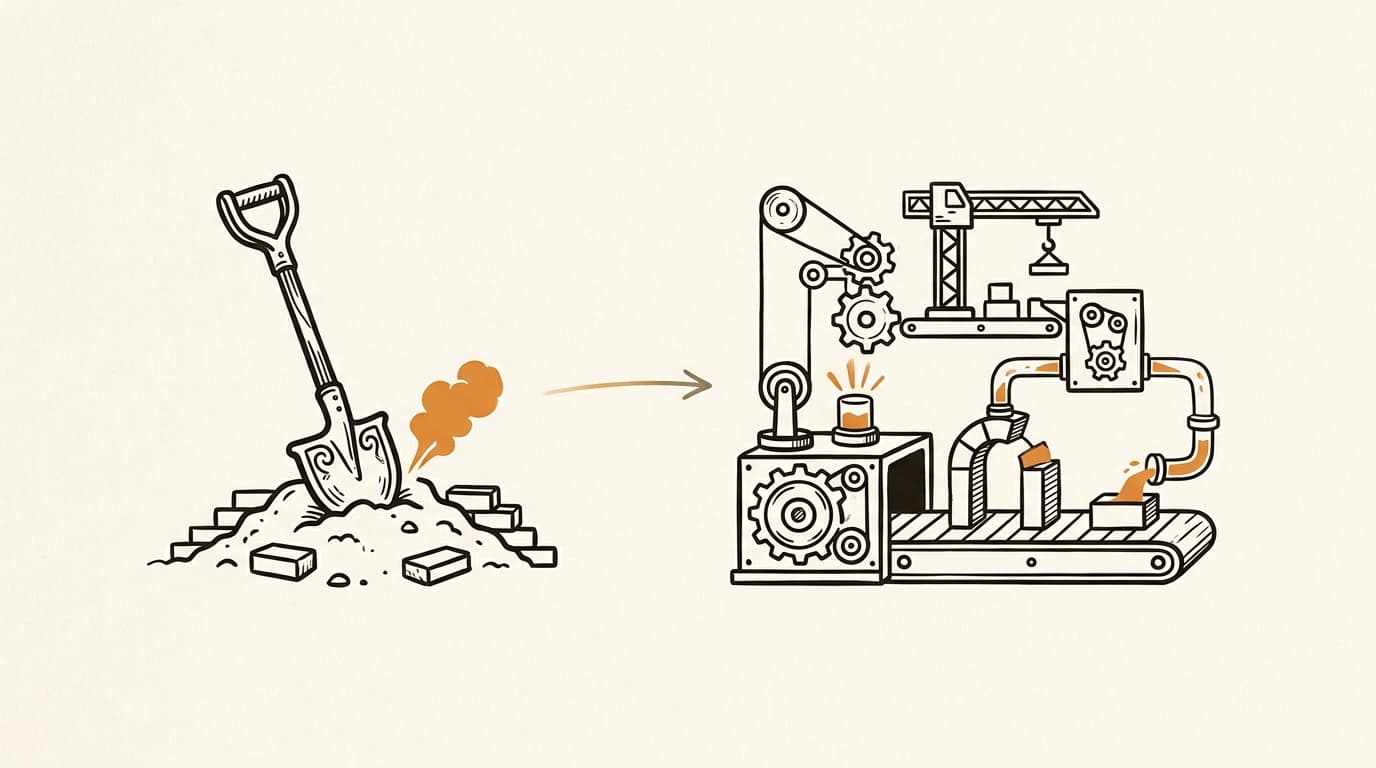
A prompt is a single instruction you give to an AI. You type something, the AI responds, you move on.
A workflow is a repeatable system. It chains inputs, instructions, conditions, and outputs together so the same process can run again — with different data, for different users, at different times — without you manually driving every step.
Marketers who only know prompts are doing creative work. They are producing one output at a time. Marketers who build workflows are doing operational work. They are building a system that produces outputs consistently, across a team, without requiring the same manual effort each time.
Both are useful. They are not the same thing. Confusing them is how people end up believing they have automated something when they have only done it once with AI assistance.
What is a prompt, and what is a workflow?
A prompt is the message you send to an AI model. "Write me a subject line for a product launch email targeting senior marketers." The AI responds. You review it, revise the prompt if needed, take the output you want, and paste it somewhere.
A workflow is what happens when you stop driving each step yourself.
A competitive brief workflow, for example, might pull updated positioning from three competitor sites, run those through a structured comparison prompt, and produce a formatted summary that goes directly to your team's shared drive — triggered weekly, without you opening a browser.
The distinction matters for marketing operations because prompts do not scale. A prompt requires you at the keyboard. A workflow requires you once, at the design stage. After that, it runs.
Can you automate marketing with prompts alone?
Not in any meaningful sense.
Prompts are inputs. A single prompt, no matter how well-written, does not move data from one place to another, trigger on a schedule, route output to the right person, or handle different inputs differently.
I have to admit: this confused me early on. I had very good prompts. I had folders of them. I thought "saving a good prompt" was the same as building something durable. It was not. What I had was a personal habit, not a system.
The difference shows up when you go on holiday. A prompt library sits idle. A workflow keeps running.
Automation requires at minimum:
- A trigger (time, event, or new data)
- A sequence (what happens in what order)
- An output that reaches the right place without manual intervention
- A human review moment before anything consequential happens
Prompts are inputs into that structure. They are not the structure itself.
What does a real marketing workflow look like?
Here is a concrete example: weekly ad copy performance review.
With prompts only: You open your analytics platform, export last week's numbers, paste them into a chat window, write a prompt asking for observations, read the response, copy what seems useful, and write up your own summary. This takes about 90 minutes each Monday and produces slightly different output depending on your mood and the prompt you happen to write.
With a workflow: Each Monday at 7 a.m., a script pulls last week's performance data from your analytics API. That data feeds a structured prompt comparing this week to the prior four weeks, with specific instructions to flag any creative that dropped more than 15% in CTR. The output is formatted as a brief summary and posted to your team's Slack channel before standup. You review it, mark anything that needs action, and move on. Total active time: five minutes.
The workflow does not write better copy than you. It makes the review process reliable enough that it actually happens every week, with enough lead time to act on it.
| Manual with prompts | Built as a workflow |
|---|---|
| You drive every step | Triggered automatically |
| Output varies with your effort | Output format stays consistent |
| Skipped when you are busy | Runs regardless |
| Cannot delegate | Any team member can review the output |
| Scales with your time | Scales with the system |
What makes a workflow actually repeatable?
Three things, from my experience.
Defined inputs. A repeatable workflow knows exactly what it is receiving. If your weekly brief workflow requires someone to paste in last week's notes in a specific format, the first time someone deviates from that format, the workflow breaks. Repeatable inputs mean structured sources: forms, API pulls, standardized templates.
Explicit instructions that do not rely on context you carry in your head. The best prompt you can write today may produce confusing output for a colleague running the same workflow in six weeks. Repeatable workflows document their logic in the instructions themselves. They explain what to do if the data looks unusual. They do not assume the runner knows what you know.
A human checkpoint at the right moment. This is not optional for marketing operations. Any workflow that can send an email, publish copy, or update a record needs a review step before the consequential action. The checkpoint is what makes the system trustworthy enough to actually use. Without it, people will not rely on it. With it, people will.
The marketers who get stuck at the prompting stage are usually missing the third item — they have not thought about where a human has to be in the loop and what that review moment looks like in practice.
Prova teaches this as the foundation
The prompt-to-workflow distinction is foundational across Prova, especially in the Operator and Builder paths.
The first few sprints are about auditing a real workflow you already do. Not reimagining your entire marketing stack. One repeated task, examined honestly. What triggers it, what inputs it needs, what outputs it produces, and where it breaks when you are not paying close attention.
From there, you build the smallest version that a real user can test. You do not build the automation first. You build the understanding first, then the specification, then the first working slice.
The review process at the end of each sprint is specifically designed to catch the most common failure: confusing "I tried this with AI" with "I built something that will still work next month without me driving it."
That distinction is where the operational value is. It is also where most marketers stop, because it requires committing to a repeatable structure rather than an interesting one-time experiment.
Cheers, Chandler