/Proof
Proof-Based Learning: What It Is And Why It Beats AI Certificates
Proof-based learning requires you to produce a real artifact — a tool, a workflow, a report — and have it reviewed against specific criteria.
Short answer
Proof-based learning is a model where completion is defined by producing a specific artifact and having it reviewed against criteria that existed before you started.
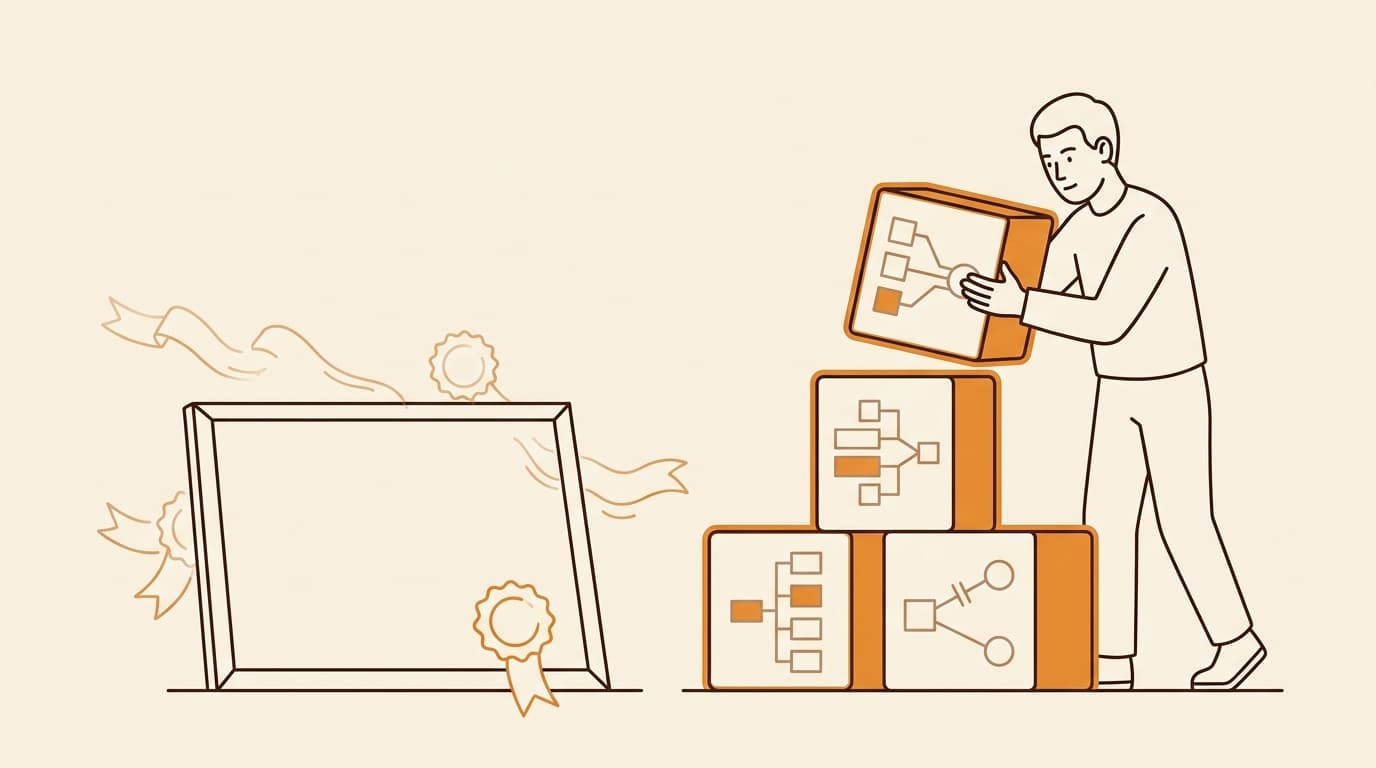
Proof-based learning is a model where you are not done until you have produced something real and had it reviewed against a standard.
Not a quiz. Not a completion badge. Not a video with a progress bar. An artifact — a built tool, a documented workflow, a tested process, an evidence-backed report — reviewed by someone who did not build it, against criteria that existed before you started.
That distinction changes what you actually learn. When you know the review criteria up front, you make different decisions during the work. You scope more tightly. You test earlier. You document the things that matter for evaluation, not just the things that feel interesting. The learning happens in the doing, but it sharpens because the doing has a specific, pre-stated endpoint.
If you want to understand why AI courses fall short, there is a longer post for that. This post is about what comes after that recognition: what the alternative actually looks like in practice.
Why AI certificates do not confirm AI skills
A certificate confirms completion of content. It does not confirm what you can do.
This matters because content consumption and skill development are different cognitive activities. Watching an explanation of how to scope an AI workflow activates recognition memory. Actually scoping an AI workflow, submitting it, getting feedback that it missed something you did not know you did not know, and revising it — that activates a different process. The second one produces judgment. The first produces familiarity.
Most AI certificate programs are structured around content completion. Finish the modules, pass the assessment (usually a multiple-choice quiz about the content you just watched), receive the badge. The assessment tests whether you remember what you consumed, not whether you can use it.
The most common thing I hear from marketers who completed AI certificate programs is: "I learned a lot but I still don't know what to actually build." That gap between knowing-about and knowing-how is precisely where certificate learning stops and proof-based learning begins.
What the artifact actually is
In proof-based learning, the artifact is the unit of completion.
An artifact for AI work is something with these properties:
- It was produced by you, not generated wholesale by an AI model
- It has observable, specific behavior or content that can be evaluated
- A person other than you can read it, use it, or test it and tell you whether it worked
- It reflects decisions you made — about scope, design, tradeoffs — not just execution of given instructions
A few examples of what this looks like for marketers building AI skills:
| Artifact type | What it demonstrates |
|---|---|
| A working AI tool with user test notes | You can scope, build, and test a functional AI system |
| A workflow audit with AI opportunity map | You can analyze a real process and identify specific, actionable AI applications |
| A build brief with test criteria | You can specify what a tool should do with enough precision for someone else to evaluate it |
| A sprint review report with evidence | You can compare intended output against actual output and produce an honest assessment |
Notice what is not on this list. A list of AI tools you learned about. A prompt library you compiled. A strategy deck about AI adoption. These are not artifacts in the proof-based sense, because they do not demonstrate that you can do the specific work — they demonstrate that you researched it.
What "reviewed against criteria" means in practice
This is the part that makes proof-based learning structurally different from peer feedback or self-assessment.
When you submit an artifact for review in Prova, the review criteria were specified before you started the sprint. You saw them on day one. The reviewer assesses whether the artifact meets those criteria — not whether they personally think it is a good idea, not whether they would have done it the same way, but whether it meets the stated standard.
This matters in two ways.
First, it gives you a target while you are building. Most self-directed learning fails because there is no clear definition of done. You keep working until it feels finished, which means your own comfort is the only quality signal. Pre-specified review criteria give you something external to aim at.
Second, it makes the feedback actionable. When feedback says "the scope definition in your build brief did not include a clear 'what this tool will not do' section," that is specific, improvable, and not a matter of opinion. You know what to fix. You take that knowledge into the next sprint. The learning compounds.
What "passed" means — and what it does not
Passing a proof-based review means the artifact met the stated criteria. It does not mean the artifact was perfect. It does not mean the process was smooth. It does not mean you could not have done it better with another week.
Well, in most cases the artifact could have been better with another week. The point of the review gate is not to produce perfection. It is to confirm that the work reached a standard that justifies moving to the next problem. Building judgment requires a sequence of reviewable outputs over time, not one perfect artifact at the end of a long process.
This is also why the criteria matter so much. If the criteria are vague ("shows understanding of AI principles"), "passed" means very little. If the criteria are specific ("the tool processes input in format X, applies the specified logic, and produces output that a new user can evaluate without additional explanation"), "passed" means something you can build on.
How AI skills become visible to employers
The portfolio question comes up often. How do you show AI skills to someone who is hiring?
Certificates are thin evidence. They confirm you sat through a course. A hiring manager cannot tell from a certificate whether you can scope a workflow, build something functional, or identify the right AI application for a given problem.
Artifacts are thicker evidence. A working tool you built, with documentation of the build brief, user testing notes, and a review report that names what passed and what you revised — that is a record of capability. It shows the problem you identified, the solution you scoped, the thing you built, and the feedback you incorporated. That is a portfolio.
From my experience, the marketers who get hired into AI-adjacent roles in 2026 are the ones who can show something they built. Not a slide deck about AI. Not a certificate in AI fundamentals. Something with a URL, a file, a demo — evidence that they did the work.
Proof-based learning is not the only path to that kind of portfolio. But it is the most direct one, because the learning process and the portfolio-building process are the same process.