/Proof
Prova vs ChatGPT For Marketing Workflows: An Honest Comparison
Prova and ChatGPT do different jobs for marketers. ChatGPT is a general assistant; Prova is a sprint-and-review program. Here is where each one fits.
Short answer
Prova and ChatGPT are not substitutes. ChatGPT is a general-purpose assistant with broad tools and memory. Prova is a sprint program where marketers submit artifacts that are reviewed against fixed criteria.
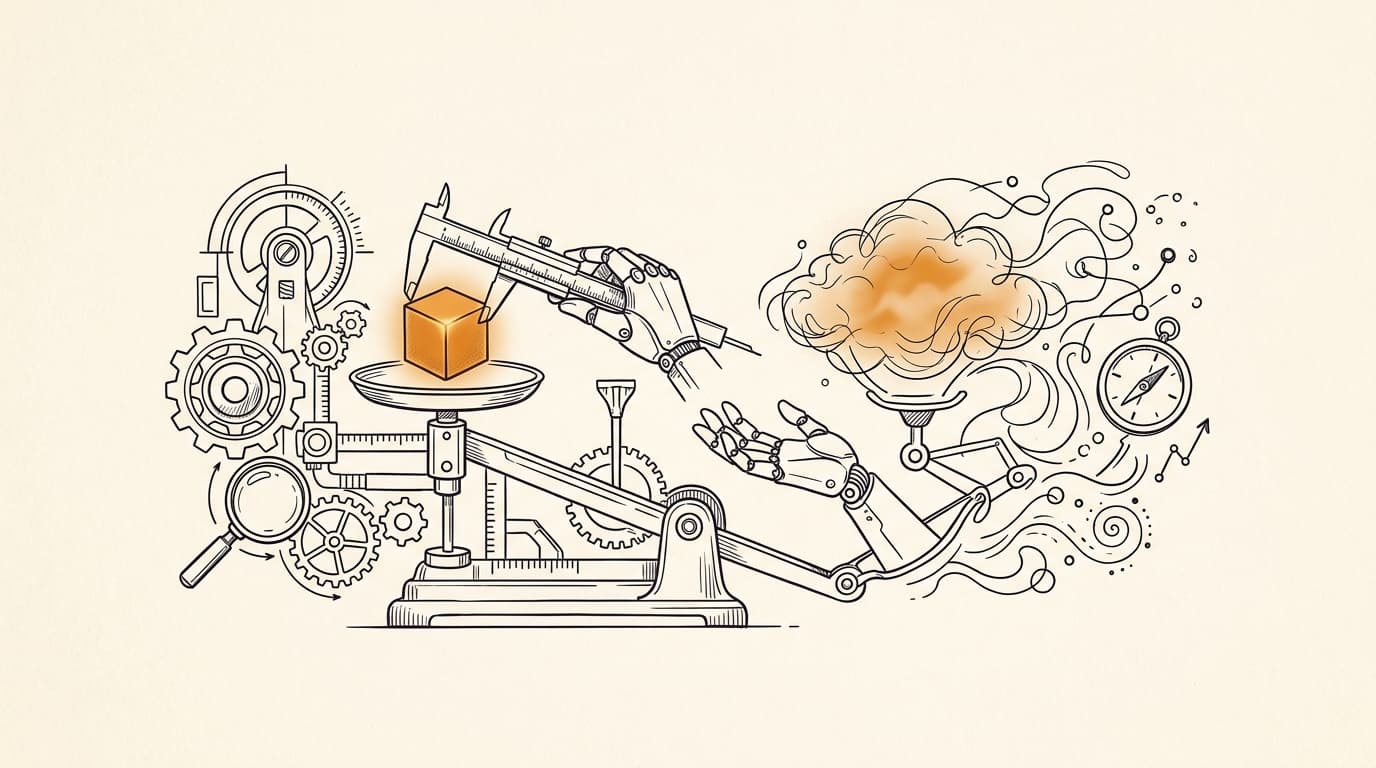
Prova and ChatGPT are not competitors in the usual sense. ChatGPT is a general-purpose assistant: you bring a task, it helps you do it. Prova is a sprint-based program: you bring a real workflow or decision, produce an artifact, and have that artifact reviewed against criteria that existed before you started.
The confusion is understandable, because both involve AI and both are used by marketers. But the question "Prova vs ChatGPT" usually resolves to a different question: do you need a tool to help you do work, or a structure that makes you prove the work holds up? Those are different needs, and often you need both.
This comparison maps the stable capability areas, not a single model version, because the details move quickly.
Originally published June 22, 2026; last updated October 3, 2026 with current OpenAI sources. Where this post says "as of" a date, it means October 3, 2026.
What is the difference between Prova and ChatGPT?
The cleanest distinction is the unit of value. ChatGPT's unit is the response to a prompt. Prova's unit is the reviewed artifact. One is a general capability you point at any task; the other is a structured loop with a gate at the end.
The capability map below reflects OpenAI's own documentation as of October 3, 2026. Treat it as a snapshot of categories, not a permanent spec. Any specific model name will age; the shape of each product is more stable.
| Area | ChatGPT (OpenAI) | Prova |
|---|---|---|
| Reasoning | Selectable reasoning effort for harder, multi-step questions | Not a model; a sprint forces the reasoning move, from problem to defended output |
| Tools and automation | Plugins and connected apps, with scheduled and event-triggered tasks | The unit of work is a sprint with a defined, reviewable artifact |
| Memory and context | Memory, projects, and custom instructions across conversations | Context is the sprint brief plus your prior submissions and reviews |
| File and document analysis | Upload files and work across connected document stores | You submit one artifact; review reads what you produced |
| Enterprise and admin | Workspace controls, role-based model access, sign-in, data protections | Solo or small-team sprints; progress gated by review, not admin policy |
| Pricing model | Free through paid consumer and business plans, with usage allowances | A monthly program with a trial; you pay for review, not model access |
The rows are not quality judgments. They describe what each product is for.
Where is ChatGPT stronger than Prova?
On breadth, ChatGPT wins clearly, and it is not close. It is one product for writing, research, coding help, image generation, voice, file analysis, and connected tools. It spans consumer and business plans, runs on every major platform, and ships improvements continuously. For a marketing team that wants one assistant for many daily tasks, it is the obvious default.
Its ecosystem is the second advantage. Plugins, connected apps, and integrations mean ChatGPT can reach into the tools a team already uses rather than sitting beside them. It also has a free entry point, which lowers the cost of trying it. None of that is a small thing.
Prova does not try to match any of this. If your need is a capable, general assistant that gets better over time and fits almost any task, ChatGPT is the stronger choice, and pretending otherwise would be dishonest.
Where is Prova different from ChatGPT?
Prova is different in kind, not in degree. It is not a more specialised assistant. It is a program built around one loop: pick a workflow, produce an artifact, submit it, and have it reviewed against criteria written into the brief before you began.
That gate is the whole difference. A general assistant will help you produce almost anything and rarely tells you it is not good enough. A reviewed sprint cannot be completed by generating output; it is completed when the artifact meets a standard you saw on day one. That is deliberate. The goal is judgment that transfers to real work, which is the same argument behind proof-based learning versus AI certificates.
It is also narrower. Prova develops depth in one workflow at a time, not fluency across every function. The AI sprint explainer covers that model in detail. If you need breadth, that is a reason to choose the assistant. If you need a defensible artifact and a review, that is what Prova is for.
Which should you use for marketing work?
Usually both, for different jobs. Use ChatGPT for the everyday work: drafting, summarising, research, spreadsheet help, the long tail of tasks. Use a reviewed sprint program when the goal is to build something specific and prove it works.
The honest test is the outcome you need. If you need output now, an assistant is faster and cheaper. If you need to be able to defend a decision to a stakeholder, an artifact reviewed against fixed criteria is worth more than a convincing chat thread, because it comes with evidence rather than confidence.
Prova is not for everyone. The self-selection guide is blunt about who gets the most from it, including the people who should not join yet. Read that before deciding, and keep the assistant either way.
Sources
Capability claims about ChatGPT are drawn from OpenAI's official documentation, fetched and re-checked on October 3, 2026. The sources below map to the capability areas in the table:
- Reasoning, memory and context, file and document analysis: OpenAI, "ChatGPT — Release Notes" — https://help.openai.com/en/articles/6825453-chatgpt-release-notes (October 2026 entries; page updated October 2, 2026)
- Pricing model and usage allowances: OpenAI, "About ChatGPT Pro tiers" — https://help.openai.com/en/articles/9793128 (updated October 2026; paid tiers)
- Tools and automation (OpenAI's "plugins" and "connected apps" categories): OpenAI, "Plugins in ChatGPT" — https://help.openai.com/en/articles/20001256-plugins-in-chatgpt-and-codex and OpenAI, "Connected apps in ChatGPT" — https://help.openai.com/en/articles/11487775-connected-apps-in-chatgpt (both updated October 2026)
- Enterprise and admin (workspace controls and role-based model access): OpenAI, "Managing feature access with role-based access control in ChatGPT" — https://help.openai.com/en/articles/11750701 (updated October 2026). The sign-in and data-protection points come from the release notes ("Sign in with ChatGPT") and the "Connected apps in ChatGPT" article (Business/Enterprise data use), both listed above.
As of October 3, 2026. Product details change; re-check the sources before relying on a specific capability or price.